Sunday, May 1, 2011

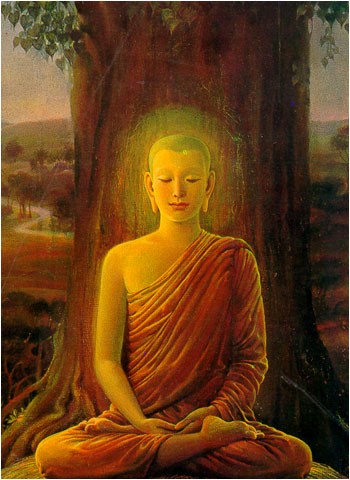
Meditation : Elixir of Life


French scientist Luc Montagnier, the 2008 Nobel prize winner (medicine) for discovery of the HIV virus, has shown that it is possible to replicate and transfer DNA strands from one test tube to another by passing a low level electromagnetic (EM) radiation of 7Hz through them.Body is repaired, rejuvenated and kept healthy by production and replication of good DNA.

Also, in deep meditation, the brain produces EM waves called theta and alpha waves ranging from 4-12 Hz but mostly in the range of 7-8 Hz. Possibly, deep and regular meditation helps in rejuvenation of the body by helping replicate good DNA. Patanjali Yoga says: "By sanyam or deep meditation on the elements, a yogi gets a perfect body of beauty, grace, strength and hardness of a thunderbolt". Meditation is like an elixir of life.
Deep meditation is basically focussing the mind on a single thought for a long time. Patanjali describes it as sanyam or a combination of contemplation, meditation and samadhi and when all these three things are achieved, it's complete mastery.

More scientific studies have shown the direct effect of meditation on DNA and gene expression, that meditation helps in delaying the process of ageing by increasing telomerase activity. Telomerase is an enzyme which repairs the DNA. Chromosomes have caps of repetitive DNA called telomeres at their ends. Every time cells divide, their telomeres shorten, which eventually prompt them to stop dividing and die. This results in the ageing process. However, telomerase enzyme stops the shortening and meditation helps in increasing the activity of this enzyme.

Another Harvard University study showed that meditation directly affects genes by switching them on and off to combat the bad effects of free radicals which are produced when we are emotionally and physically stressed.

Similarly, during the dreaming process the brain produces 4-7 Hz theta waves. Sleep and dream research has shown that deep sleep and dreaming is necessary for our well-being and helps us in consolidating our daytime memories and in removing some of the frivolous ones. However, it is quite possible that besides the memory consolidation, 4-7 Hz EM waves may also help in rejuvenating the body and mind by enhancing the replication of DNA.

The DNA teleportation experiment also showed that DNA template was teleported from its dilute solution in a test tube to another one containing only water; that low level radiation of 7 Hz produced a memory in water which matched the DNA molecule. Water with its unique weak hydrogen bond capability can form almost infinite number of structures and it seems the low level radiation simply helped in this process.

The ability of water to form "memory structures" under external influence could also be the basis of achaman, a ritual of sipping water after reciting Vedic mantras that is believed to have therapeutic effect on its practitioner. Chanting creates a "memory structure" in water, somewhat like homoeopathic medicine where high potencies don't have original medicine in it but the "memory structure" of the medicine persists in water.

Ref: http://www.damazen.com/blog/

http://mrgrim2dareapa.blogspot.com/2009/09/audio-meditation.html

Saturday, April 9, 2011

Return to Innocence


Live from the heart; with an open heart, you can feel things as they are without the burden of past conditioning, writes Paula Horan
Happiness is something we all unconsciously seek and more so when times get tough. Ironically, I have discovered, after many years of trial and error, that happiness is not the ideal objective. Life is fraught with ups and downs, even in the best of times. There will always be periods of happiness and periods of pain, comfort and discomfort. Thus the equanimity which fosters contentment is perhaps a wiser aspiration which when pursued, requires us to wake up to who we are, minus the veil of ego.
It is eminently more practical, to get in touch with and anchor ones attention with the true self — the awareness within us which is unaffected by life's ups and downs — than to try and "fix" the mind and make it happy. Fixes are always only temporary. It behoves us to discover the 'beingness' that we are, which rests in a perfect state of equanimity, no matter what outer circumstances may be; whether they are good or bad.
Shed your ego
It is ultimately who we are, minus ego identification. This presence is always with us, for it is our essential nature, yet while we are identified with a busy mind, we fail to notice it. A certain shedding of mental burdens has to happen so that it can be felt and directly experienced. The most direct way to do this is to shed the burdened one with all of its various masks. For this to occur, the illusory experiencer (ego) has to be unveiled.
From this perspective, the problems and challenges of everyday life take on a whole new meaning. All at once, nothing changes and yet everything changes. We cease to take life so personally because we realise there is no "personal" self to begin with. Instead, we begin to perceive the vastness of who we are: wholly indefinable, wholly unknowable.
As we begin to peek through the boundaries of the conceptual mind, our previous comfort zone, bound by our encyclopaedic memory of the past, with continued noticing, loses its hypnotic quality. The freshness of living a true present, unaided by past programming, gradually becomes more appealing.
What is called for now, is a return to innocence, an innocence which must be intensely present with what is. Fierce energy keeps us in the present. The fierceness is not to protect our innocence, for it needs no protection, but to make it come alive, to fuel an open heart. Contrary to what we normally think, true strength lies in the vulnerability of an open heart; not in a heart which is closed. With an open heart, we can feel things as they are without the burden of past conditioning.

Show more Understanding

There is a story of a holy man from the Middle East who was in the habit of not eating breakfast each morning until a hungry person came by to share it with him. One day, an elderly man came by. The holy man saw him and invited him to share his breakfast with him. The elderly man thanked him profusely and sat down at the table to join him. As they began to say a blessing over the food, the elderly man said aloud a prayer to the pagan gods. The holy man was taken aback since he only believed in one God. He felt that the elderly man was a non-believer and so he became very upset. "If you believe in pagans, then I don't want you in my house!" he said to the old man, who scurried off. 

When the holy man returned to his table, he heardGod speak to him. God said, "What right have you to send that man away?" The holy man said, "He did not believe in you." God replied, "Look here! I know he does not believe in me. But I have been supplying the unbeliever with food every day for eighty years even though he doesn't believe in Me. Couldn't you tolerate him for one single meal?"

We sometimes become righteous about our own beliefs and our own goodness and look down upon others. Who is good and who is bad? No matter how bad we think someone is, God provides for everyone. There are people who lie, who cheat, who deceive others, and who slander others. There are people who hurt others and even kill others. It takes all types to make the world. Some of us believe in a God, others don't; still others are agnostics. Yet, God provides life to each of them. No one is perfect.

Even those of us who are on the spiritual path feel righteous about ourselves. Some people criticise others who do not meditate as much as they do, who do not do as much service as they do, or who do not live by the ethical values as well as they do. Sometimes people become very outspoken about the faults of others. But have we ever analysed our own selves? Is it our duty to become the reformers of others? We should accept the fact that no one is without fault. God knows everyone's faults. God sees everything we do and everything everyone else does.

We should be kind and loving to all. We should respect and learn to live amicably with people who have different beliefs and customs from those that we have. Why be critical of non-believers and agnostics? Are we not entitled to believe in what we are convinced about, as long as we do not hurt anyone?

God has made a world with people following many different religions and yet provides for each of them. Each one of us is different; this fact alone should enable us to show more understanding to those who do not agree with us. When we show love and understanding to all, then we are acting like true children of the Lord. God is love, and when we show love for others, we too are filled with love and come closer to God. 

Why we suffer


Shantanu Nagarkatti tells us how to overcome misery. A report by Mansi Choksi


In the Yoga Vasishta, Sage Vashishtha tells Prince Rama the story of the enlightenment of Leela. "This story is for those who have lost a dear one, who live in pain and for those of us who are plagued by the anxiety of anticipatory loss," said Nagarkatti.
Leela was the beautiful wife of King Padma — a fair, wise and kind man regarded as the 'lotus of his race'. They were deeply in love. Often, she would be overcome with fear, when she would think of the possibility of losing him. The fear became so overpowering that it sometimes prevented her from enjoying his company and even the present moment.
Leela called on all the wise men in her court to find a solution to her problem. They advised her to engage in tapasya, fasting and meditation so that goddess Saraswati could show her the way. She chanted for days in secrecy and finally Saraswati appeared. "She asked the goddess for two boons: first, that she would appear each time Leela called her and second, that when Padma's soul left his body, it would not leave the room they shared," recounted Nagarkatti.
Decades later, Padma passed away. As Leela sat next to his lifeless body, she was overcome by sorrow.
Nagarkatti explained: "Patanjali says that all unhappiness arises from advidya or ignorance; when we seek permanence in impermanence," he said. "We look for sukham or happiness in things that are designed to cause dukham or sorrow. The nature of the world is to change and we always look for something to hold onto — the idea of I, me, myself."
As Leela sat in her room, plagued by sorrow, she called out to goddess Saraswati. "Let me see where my husband is," she pleaded. The goddess obliged, and Leela went into a trance and saw her husband looking younger, sitting on his throne and ruling over his kingdom. She went to him, spoke to him, tried to embrace him, but he couldn't see her or feel her.
Befuddled, she asked Saraswati, if what she had just seen was a dream or a reflection of her world. "How do you know that what you're experiencing now is not an illusion?" Saraswati asked. "When one is in a dream, everything seems real — tears, blood, pain and even happiness. You realise it's a dream only when you wake up," said Nagarkatti.
She told Leela that there were three dimensions to existence — bhoota akasha or physical, chitt akasha or psychological — which drives the bhoota akasha with the karmas stored in it, or the spiritual dimension, the highest state of being, which is limitless. In this stage, there is no duality, and dwesha. "There is not one universe, but multiverses, not one Padma but several Padmas," said Nagarkatti. With meditation, one can enter the chitt akasha that traverses time and these universes.
Leela undertook nirvikalpa samadhi and reached the highest state of consciousness. Through her travels, she came across mourners near a hut and asked what had happened. The relatives wept furiously and said that this was the hut of Sage Vashishtha and his wife Arundhati and that they had passed away eight days ago. But they could feel their presence in the room.
Goddess Saraswati told Leela that Vashishtha was none other than Padma and Arundhati was none other than Leela. One day, the learned Vashishtha had noticed a huge procession of royalty and had said, "How wonderful it would be to be a king". That wish was granted and he was reborn as Padma. "That's why, be careful of what you desire. As Oscar Wilde said, when God wants to punish you, he fulfils your desire," Nagarkatti said.

Wednesday, October 13, 2010

Awaken the Kundalini shakti

The nine-day festival of Navaratri is indeed hallowed and venerable. The performance of daily rituals, spiritual practices and invocation of goddesses Durga, Kali, Saraswati, and Lakshmi are in deference to the different forms of Shakti, the primordial cosmic energy, the divine feminine creative power.


Sages have explained the union of Shiva and Shakti. Shakti represents the primordial cosmic energy responsible for the processes of creation and destruction that occur unceasingly. The foundation of Shiva is the all-pervading Supreme Consciousness, without which even Shakti cannot function. The primordial cosmic energy is referred to as Devi the one who creates, preserves and destroys.

Devi is all-pervasive and is present even in our body as well, as kundalini. This lies dormant in the muladhara chakra situated in the subtle body, invisible. It is symbolised by a red-coloured inverted triangle. As long as this energy remains dormant, human life cannot evolve, cannot attain greater heights.

Yoga, especially raja yoga and chakra yoga detail practices required to awaken the dormant energy that lies dormant in the muladhara chakra, whereas Shiva resides in the sahasrara chakra, at the top of the head. When Shakti and Shiva unite, we experience spiritual awakening and uplift. In most, the union does not occur in their lifetime and hence they live their lives at a very low level of consciousness.

The transformation that happens in a person's life when the kundalini gets awakened is phenomenal. Science differentiates between matter and energy. However, tantra regards them as one matter is the gross form of energy and energy is the subtle form of matter. The divine essence of this energy is called Shakti.

One cannot attain spiritual evolution without the presence of Shakti. As long as this energy is lying dormant, human life stagnates at subhuman levels of consciousness.

It is for the awakening of this very energy, the kundalini, that ancient sages prescribed spiritual practices and invocation of the Mother Goddess in her various avatars for a period of nine days. On all nine days, the faithful who venerate Devi observe fasting, perform spiritual practices and rituals and lead a virtuous life.

However, this is not to say that Navaratri is merely fasting, engaging in rituals and restricting one's diet to pure vegetarian fare or abstaining from alcohol. The mysterious, abstruse significance can only be fathomed by the one for whom the virtuous way of living is not restricted only to the Navaratri season but is adopted for whole of one's lifetime.

It is perfectly all right to house and worship an idol of the Devi Durga. However, bear in mind that as long as you don't take efforts to awaken the inner primordial cosmic energy, the Devi who resides in you, you will be unable to comprehend the profound spiritual significance of Navaratri.

Shakti and Shiva are incomplete without each other. This entails then that unless the Shakti inherent within you is awakened, until it ascends upwards piercing all the chakras and merges with Shiva at the sahasrara; until then Shakti cannot be the source of bliss and wisdom.

The nine days of Navaratri is an opportunity to perform and observe spiritual practices for awakening of Shakti. The importance of this should sink in so that you realise that if your entire life's pursuit is just about sensual gratification and fulfilment of worldly desires then you haven't as yet known the essential nature of Devi Durga.

Sunday, September 26, 2010

Chanting as Therapy

If you are searching for God, any name of God is a mantra. If you know the significance of the mantra, you will feel more comfortable. 

When you know the meaning, you know what you are doing ... but without knowing, it can also become clear. Mantra means "that which can take one out of the flow of life's miseries". It's a very beautiful thing; it has that power. Mantra is for the awakening of the Self. 

If something is good for you it doesn't have to be a secret. Every tradition, every sect has something good. Sometimes we are so complicated that to become a good person we have to follow a sect or a tradition and give our life to that. After 15, 30, 50 years, your seed will grow. If the method is to repeat five mantras, give your life to that and be patient; maybe your seed can grow.

Now nothing is secret, everything is written in the scriptures. Look up the Internet and you will find everything, but there is one thing more beautiful and that is the touch of a person. In these days there is no need of teachers, of schools because the Internet is there, but the touch of a teacher is needed because there are many things that we cannot learn from machines. The master's purpose is to give you a special touch, a touch that the Internet cannot give you. The touch of the master is important to give you the mantra because it has some vibration, some energy, some force. It is not a visible thing.

Reciting mantras, sometimes aloud and other times silently, could impact our psychology positively. Our psychology is always changing: we feel good, we feel bad. When something inside us starts speaking, we can repeat mantras and all our problems finish. Suppose we are very fearful and it's dark. We are alone and we have fear; our mind tells us, "Chant a mantra" and we start chanting and our fear goes away.

Psychologically, we need is some support, some help. The whole process is therapy.

Forgive and relieve yourself !!


When we respond negatively to people and situations, we set in motion a negative trend in our entire body system. 

All our emotions are electro-chemically charged and intrinsically connected to the endocrine, nervous and immune systems through our thoughts and feelings. If the systems are negatively charged, they set in motion a chain of negative reactions. Hence we need to respond carefully to situations in life.


When American journalist Norman Cousins, became very ill his doctors, finding the prognosis poor, had to give up on him. In a few days, he would be gone. In his state of illness, Norman Cousins was convinced that negative emotions have negative physical consequences just positive emotions will impact the body in a positive way. So he rented really humorous movies and began watching them regularly

He noticed that he was able to sleep more without the aid of sleeping pills. The pain that was excruciating was reducing. He was now less dependent on painkillers. Once he became well, he wrote of his experience in the British Medical Journal.

Art Mathias was allergic to hundreds of food items including fibre. He could wear only cotton clothing, and these were expensive. The prognosis being bad, doctors reluctantly gave up on him.

One day, he listened to a teaching on forgiveness and simply decided to forgive those who hurt him. He suddenly realised from that day he could eat many foods, to which he was allergic. Even his skin allergies stopped. Behind this phenomenal healing was the major shift he made in his thinking, that is, to move from harbouring bitterness to forgive and bless those who hurt him.

For both Norman and Art, the turning point was their attitude towards health and hurts. The World Health Organization (WHO) reported in 2002 that one out of every three persons, who went to consult doctors for a common symptom got diagnosed with some form of mental illness arising from anger and depression. To a large extent, many of us suffer a degree of anger and depression. A great many of our physical sicknesses could be avoided if we could only change our attitudes.

In our reactions to failures and disappointments, which are bound to occur, it is good to make an effort to avoid bitterness, anger and resentment. Neurologists tell us that the neuron, which is the basic unit of the brain, was created by God for love. When you and I experience God's love and find others to express our love, every organ in our body will function to its optimum level. Hope and confidence itself will produce positive energy in the body.

Tuesday, August 17, 2010

It's all in the mind

Do you honestly want to start taming your mind and be happy? Do you have the right motivation and intention to begin? Are you serious about it? If the answers to these questions are 'yes', know that there are three prerequisites to keep your mind under control:
First, there cannot be a beginning without knowing what to begin on. So, first, get started on the teachings. Although as Buddhist I would recommend the Buddha Dharma to you, you may choose any other teachings. Whatever you decide on, please have confident faith in it. You need to have a competent teacher to help you find answers to questions, to enable you to overcome roadblocks on the way. Masters say: "Learning to meditate without proper understanding of the teachings is like trying to climb a tree with no hands!" You must know what to meditate on before starting, and for this, you need to have a reasonable understanding of your lineage teachings. A special motivation or bodhichitta must be humbly awakened within to begin spiritual practice.

Second, Tibetan wisdom says: "Gompa ma yin, kompa yin", which means: Meditation is not, getting used to is. Meditation cannot be 'done', or for that matter done sporadically. It is not enough to stay calm during the practice and be volatile right through the day. You have to get so comfortable with meditation that it becomes embedded in your system. It becomes something that we can do anywhere and anytime and then finally all the time! However, to reach this stage, you have to calm the mind to a reasonable level of steadiness. How? The Buddha taught 84,000 ways to calm down and ease negative emotions. There are countless ways to meditate, choose yours. Be regular with your meditation; assign a time for it daily. Early mornings suit me.

Finally, be ever vigilant of the mind, of its thoughts and emotions. In an average human mind, over 50,000 thoughts and emotions come and go each day. Just let them be. Don't engage them. Especially the disturbing, negative ones. Let them rise and fall. Be at peace with their rise and subsequent fall. Never get difficult with them. They will go just as they have come. Look at the mind like an ocean and the rising and falling thoughts and emotions like the waves. Whoever has heard of the ocean being disturbed by the waves? Be like the old grandfather watching the child play. He knows the pranks going on and is amused by them too, but is vigilant of the child not causing any harm to himself or to anyone else around. In short, be mindful. The mind can slip away faster than you have realised its departure.

We take so much trouble and spend much money to get physical exercise in a gym. Why not consider a little bit of time and no money for our mind's wellness too? Imagine a world of people with strong bodies and untamed minds! It would be a terrifying place to live in, isn't it? An approach to tone both would be in everyone's interest.

Now that you will begin in right earnest, whatever goodness accrues from this, dedicate all of it to your near and dear ones, your teacher, the elderly or those you are indebted to in your life and other sentient beings around you. This way more benefit, peace and happiness will come your way.

May the Buddha smile upon you.

Wednesday, August 4, 2010

True Religion

At the present moment, no one actually knows the meaning of religion. Religion means to abide by the laws of God, just as good citizenship means to abide by the laws of the government. Because no one has any understanding of God, no one knows the laws of God or the meaning of religion. This is the present status of people in today's society. They are forgetting religion, taking it to be a kind of faith. Faith may be blind faith. Faith is not the real description of religion. Religion means the laws given by God, and anyone who follows those laws is religious, whether a Christian, a Hindu, or a Muslim.

The religious system might have been misused, but that does not mean that religion should be avoided. Real religion should be taken. It does not mean that because religion has not been properly executed by the so-called priests, religion should be rejected. If my eye is giving me some trouble on account of a cataract, it does not mean that the eye should be plucked out. The cataract should be removed. That is Krishna consciousness.

Tuesday, July 27, 2010

The sky nature of mind

In every sentient being the buddha mind is omnipresent. We don’t have to go looking for it. We don’t have to strive to perfect it. It has been with us since birth and it is always perfect! Just as the sky. This is the nature of our mind. Who would want to strive to perfect a cloudless sky? 

All of us want to be happy at all times. So why do our actions of body, speech and mind work often in contradiction to what we really want, bringing suffering in its wake? The reason is simple; it’s because we allow them to. We could correct this; we can attempt to clear the clouds that obscure the beautiful sky. 

What is holding us back from exploring the brilliance of the sky? The four faults, as enumerated below: 

Too close: Have you ever tried to see your face without something that could reflect it? Not possible. Similarly, the nature of the mind is so close to our mind that it finds it difficult to see it. 

Too profound: How often have you waded into unknown waters? You take a few steps and the fear of the unknown stops you. Similarly, we have no idea how deep the nature of mind would be. We cannot fathom its depth. So we don’t make an attempt. 

Too easy: It is often that we have not attempted something simply because it was too easy. So it is with the nature of mind. Something that has always been with us, always perfect, gets a priority that is low amongst other worldly distractions & attractions. 

Too wondrous: How many times have we left something untried because we see it as an immense task? We just don’t believe that we can actually attain enlightenment which is the essential nature of our minds. 

The Tibetan word for ‘Buddhist’ is nangpa, which means `insider’, that is, alluding to the fact that one has to learn of living and dying not from external sources but from knowing the nature of mind. However, people fear to look within themselves, not knowing what they will find. Whether they will be able to face what they will find. They are afraid that they will be treated like social outcasts amongst friends, left alone to live life in solitude. And this conceptualised, misplaced approach plays perfectly into the ploy of the wily ego that could have asked for nothing more than this. 

The answers you genuinely seek will come to you only from within, from the nature of your mind and not the nurtured mind. Even if you get the most accomplished teacher, his only responsibility will be to guide you through unknown pathways with the help of teachings and practices, cutting through obscuration of a contrived mind and make you discover the true nature of your mind. And in doing so, help you dispel the fears of sickness, old age and death and understand better the prospect of life, death and afterlife. 

It needs endeavour. Let the winds of awakening blow away the clouds from the sky nature of your mind. Introduce yourself to the perfect sky that is your very own and has always been with you. This is the only happy way out from here! Buddha hood to you! 

Sunday, July 11, 2010

The river of life


I don’t know if on your walks you have noticed a long, narrow pool beside the river. Some fishermen must have dug it, and it is not connected with the river. The river is flowing steadily, deep and wide, but the pool is heavy with scum because it is not connected with the life of the river, and there are no fish in it. It is a stagnant pool, and the deep river, full of life and vitality, flows swiftly along. 

Now, don’t you think human beings are like that? They dig a little pool for themselves away from the swift current of life, and in that little pool they stagnate, die; and this stagnation, this decay we call existence. That is, we all want a state of permanency; we want certain desires to last forever, we want pleasures to have no end. We dig a little hole and barricade ourselves in it with our families, with our ambitions, our cultures, our fears, our gods, our various forms of worship, and there we die, letting life go by – that life which is impermanent, constantly changing, which is so swift, which has such enormous depths, such extraordinary vitality and beauty. 

Have you not noticed that if you sit quietly on the bank of the river you hear its song – the lapping of the water, the sound of the current going by? There is always a sense of movement, an extraordinary movement towards the wider and the deeper. In the little pool, there is no movement at all; its water is stagnant ... This is what most of us want: little stagnant pools of existence away from life. We say that our pool existence is right, and we have invented a philosophy to justify it; we have developed social, political, economic, and religious theories in support of it, and we don’t want to be disturbed because what we are after is a sense of permanency. 

To seek permanency means wanting that which is pleasurable to continue indefinitely, and wanting that which is not pleasurable to end as quickly as possible. We want the name that we bear to be known and to continue through family, through property. We want a sense of permanency in our relationships, in our activities, which means that we are seeking a lasting, continuous life in the stagnant pool; we don’t want any real changes there, so we have built a society which guarantees us the permanency of property, of name, of fame... 

Life is like the river: endlessly moving on, ever seeking, exploring, pushing, overflowing its banks, penetrating every crevice with its water. But the mind won’t allow that to happen to itself. The mind sees that it's dangerous, risky to live in a state of impermanency, insecurity, so it builds a wall around itself ... 

Religion is the feeling of goodness, that love which is like the river, living, moving everlastingly. In that state ... there is no longer any search at all, and this ending of search is the beginning of something totally different. The search for God, for truth, the feeling of being completely good – not the cultivation of goodness, of humility, but the seeking out of something beyond the inventions and tricks of the mind, which means having a feeling for that something, living in it, being it – that is true religion. But you can do that only when you leave the pool you have dug for yourself and go out into the river of life. 

Sunday, July 4, 2010

Winning hearts and minds


 Some people have inherent special qualities that enable them to master all situations. Such individuals can, when they come to a gathering, win the hearts and minds of people simply by making an appearance there. It is said of them: “They came, they saw, they conquered.”

This kind of ability to win love is not the monopoly of extraordinary people. Any ordinary person also can win the hearts and minds of people, provided he knows the law of nature and can avail of it by the power known as the power of spirituality.

According to the Creation Plan of God, all human beings have two different qualities: ego and conscience. The ego symbolises arrogance, and the conscience, modesty. For instance, there could be a difference of opinion between two individuals, A and B. A might enter into a heated exchange, refusing to give B due respect and honour. This kind of behaviour is bound to provoke B, who might try to teach A a lesson. A psychologist offers this analysis: “When one’s ego is touched, it turns into super ego and the result is breakdown.”

In this case A presented a challenge to B and B’s ego gained the upper hand due to arrogance. On the other hand, if, instead of getting provoked and acting out of ego, had B had opted for a compromise, or if A had restrained himself from provoking B in the first place, there would be no conflict.

In all likelihood, greater understanding would enable better relations between A and B; they would no longer be rivals bent on outdoing the other. There is scope for friendship now where earlier, there was only ill feeling. When one’s conscience is touched, it turns into super conscience and the result is complete surrender.This formula is within our reach, and can be used quite successfully. However there are certain risks involved.

There is every possibility that in a sensitive situation where the ego is involved, the other person becomes even more arrogant. He will react more aggressively. He will be more dangerous than before. But that is only if you allow the ego to become your master. The ego is a bad master but a good servant. Fear of a situation arising in which one is completely directed by the ego is unfounded, because when the ego gains predominance it is because of ignorance of the power of nature, or more precisely, the power of spirituality. So all one needs to do is to try and be less ignorant; to learn how to think positive and keep one’s ego under control.

According to nature if you challenge someone’s ego, your success is doubtful but when you challenge someone’s conscience, then your success is guaranteed by nature.
People generally know the power of fighting but a wise man will tell you that the power of spirituality is greater than the power of either ego or conscience. At the time of a controversy, if you choose to fight, you will need arms but when you opt for the spiritual method, you don’t need any arms. The power of positive behaviour can triumph over the power of negativity, while the power of negativity cannot win anything -- it can only lead to destruction.

The choice is ours: To opt for positive, peaceful methods to create better understanding and oneness, thereby contributing to universal togetherness with compassion and surrender or to take a combative stand, giving the ego a free hand, causing unhappiness all around. 

Thursday, June 17, 2010

Golden Egg Technique


When you purify your centre, you become receptive to higher vibrations. Creativity happens in this space. 

Carnatic music composer Thyagaraja discovered a new raga by listening to a bee. A monk observing a snake and a crane fighting discovered the martial art, Tai Chi. 

When your centre is full of impurities, your perspective and understanding are confused. This confusion tends to act as blockages and so there is no scope for the blossoming of creative ideas. Hence there is the need to set about clearing the obfuscation. 
When purification happens higher vibrations flow in. New ideas become understandable. We should thus insulate ourselves from negativity and keep our centres pure and receptive, so that the higher states of consciousness can guide us. 

There’s a technique called the golden egg technique: Imagine that there is an egg and in it there exists gold. The gold is hidden inside the egg. Treat every problem you encounter as one such egg. Imagine that there is a golden opportunity hidden inside every problem. Whenever you are faced with a problem, don’t lose hope. Instead of getting disheartened, try to understand that it is only an egg with precious gold tucked away deep inside. Delve deep into the problem and recognise golden opportunity. This attitude will invoke creativity in you. 


Here are many more ways of dealing positively with problems. Try this. When you come face to face with a problem, think of at least 20 ways of dealing with it. Play a game. Write down all the possible solutions. OK, now that you’ve written down 20 options, choose five out of the 20 and begin working on them. With those five kinds of solutions, find 20 ways of fulfilling them. Ask your friends to give ideas. The mother of creativity is the attempt to generate ideas. Play with it. 


There are no winners in an argument. Hence use words wisely. When someone expresses something, try and understand their point of view instead of branding and labelling them as something or other. The moment you brand them, you will see only the labels. As a result you miss seeing the person.

Stop treating differences as conflicts. View them as points of view. Learn to appreciate variety. Appreciate differences rather than viewing them as pain. The moment you relate to differences as pain, you will experience them as pain. View differences as creative versions and you will feel positive energy flow through you. 

Monday, June 14, 2010

Smile Smile Smile .... :D ,


A research done in England found that a baby smiles 400 times a day, an adolescent 17 times and an adult doesn't smile at all!  The more successful one keeps a very stiff face.  Is roughness a sign of success?  Is being stressed a sign of prosperity, growth or dignity? 
  
You should smile more.  Every day, every morning, look at the mirror and give a good smile to yourself.  You know what happens when you smile?  All the muscles in your face get relaxed.  The nerves in your brain get relaxation, and you get the confidence, courage and energy to move on in life. 
  
You know, your smile is so fragile!  Just one telephone call is enough to take it away!  Just see why your smiles go away? It may be because somebody said something stupid to you.  And why did they say a stupid thing?  Because they had some garbage they needed to throw out and you were there, ready to catch it!  And once you have caught it, you hold on to it so passionately!  


Wake up! Don't let your smile be snatched away by anybody!
 

Tuesday, June 8, 2010

Your Belief Window

We don’t see things as they are; we see things as we are. You may not be aware of this little-known but highly important part of your person that affects many of the decisions you make and how you behave in different situations. It is your Belief Window.

You cannot actually see your Belief Window because it’s invisible, but we all have one. It is figuratively attached to your head and hangs in front of your face. Every time you move, that window goes with you. You look at the world through it, and what you see is filtered back to you through it.

Your Belief Window is always there with you, filtering what you see - the oceans of data and information helping you make sense of the world around you. It influences the way you perceive others, the way you read situations, and the feelings you have about yourself. 

The tricky thing about the Belief Window is that you have placed perceptions on it which you believe are absolutely true, whether they reflect reality or not. For example, your experiences and social feedback may have caused you to believe that you are smart, stupid, beautiful, ugly, competent, incompetent, creative, or dull - regardless of whether they are true. And because you believe them you unquestioningly act as though they are. That’s why changing our behavior is sometimes such a difficult task.

Until we realize that we view the world through our Belief Windows and that it constantly filters our experiences, we will continue to think that we see life “as it really is.” 

One of the most important things we can do is to make sure our Belief Window is as clear as possible and truly reflects the reality. This may be the most difficult thing to do. You will probably have to swallow your pride, and admit that you do have a Belief Window that affects much of what you do, and recognize that some of the things you’ve placed on it are incorrect. In doing so, you will have achieved the critical first step in freeing yourself from erroneous self-ideas that may be impeding your progress. 

Friday, June 4, 2010

Water The Roots

Actually our position is that we are always rendering service to someone, either to our family, country, or society. If we have no one to serve, sometimes we keep a pet cat or dog and render service to it. All these factors prove that we are constitutionally meant to render service, yet in spite of serving to the best of our ability, we are not satisfied. Nor is the person to whom we are rendering that service satisfied. On the material platform, everyone is frustrated.

The reason for this is that the service being rendered is not properly directed. For example, if we want to render service to a tree, we must water the root. If we pour water on the leaves, branches and twigs, there is little benefit. Similarly if the Supreme Personality of Godhead is served, all other parts and parcels will be automatically satisfied. Consequently all welfare activities as well as service to society, family, and nation are realized by serving the Supreme Personality of Godhead.
It is the duty of every human being to understand his constitutional position with God and to act accordingly. If this is possible, then our lives become successful. Sometimes, however, we feel challenging and say, "There is no God," or "I am God," or even, "I don't care for God." But in actuality this challenging spirit will not save us. God is there, and we can see Him at every moment. There are different features of the Supreme Personality of Godhead because He is the original root of the entire cosmic manifestation. 

Sunday, May 16, 2010

Path of Devotional love


A devotee should always, every moment, remember his soul relationship with Radha-Krishna and feel affinity. The more you remember, the closer you get to Them. 

You can even feel Their touch, fragrance or the perfume of the garland They are wearing. You should try to visualise in your imagination any leela of Braj, Vrindaban or Barsana where you are either an observer or participant in that leela. You can be very close to Radha Rani or Krishna in the leela or be in the crowd, as you prefer. 

Meditation means feeling the divine presence of Radha-Krishna. While remembering Radha-Krishna experience the love, affinity and longing for Radha-Krishna in your heart. You will then begin to feel Their presence. hile thinking of Their form think of Their full youthful form. 

During chanting it is easier to pay full attention to meditation and engross oneself in divine love feelings. The rhythm of the chant helps to develop emotional feelings, and the sound of the music protects the devotee from outer disturbances.

Bhakti is the selfless remembrance of Radha-Krishna. The practical and best way of Krishna devotion is to increase the longing for the vision of Radha-Krishna and to remember the divine relationship; meditate on the form and the leelas of Radha-Krishna affectionately. This meditation should be followed either by the continuous remembrance of the name of Radha-Krishna in the heart or the chanting, whatever one prefers or whatever suits one’s nature.

Thursday, May 6, 2010

Om Mani Padme Hum


                                                                Lord Bodhisattva Mei Ling

Tibetan Buddhists believe that saying the mantra (prayer), Om Mani Padme Hum, out loud or silently to oneself, invokes the powerful benevolent attention and blessings of Chenrezig, the embodiment of compassion. Viewing the written form of the mantra is said to have the same effect.

Meaning of the Mantra:


"There is not a single aspect of the eighty-four thousand sections of the Buddha's teachings which is not contained in Avalokiteshvara's six syllable mantra "Om Mani Padme Hum", and as such the qualities of the "mani" are praised again and again in the Sutras and Tantras.... Whether happy or sad, if we take the "mani" as our refuge, Chenrezig will never forsake us, spontaneous devotion will arise in our minds and the Great Vehicle will effortlessly be realized."

"Buddha of great compassion, hold me fast in your compassion. From time without beginning, beings have wandered in samsara, Undergoing unendurable suffering. They have no other protector than you. Please bless them that they may achieve the omniscient state of buddhahood.

With the power of evil karma gathered from beginningless time, Sentient beings, through the force of anger, are born as hell beings and experience the suffering of heat and cold. May they all be born in your presence, perfect deity."

The True sound of Truth


An old story speaks about a similar problem. A devoted meditator, after years concentrating on a particular mantra, had attained enough insight to begin teaching. The student's humility was far from perfect, but the teachers at the monastery were not worried.
A few years of successful teaching left the meditator with no thoughts about learning from anyone; but upon hearing about a famous hermit living nearby, the opportunity was too exciting to be passed up.
The hermit lived alone on an island at the middle of a lake, so the meditator hired a man with a boat to row across to the island. The meditator was very respectful of the old hermit. As they shared some tea made with herbs the meditator asked him about his spiritual practice. The old man said he had no spiritual practice, except for a mantra which he repeated all the time to himself. The meditator was pleased: the hermit was using the same mantra he used himself -- but when the hermit spoke the mantra aloud, the meditator was horrified!
"What's wrong?" asked the hermit.
"I don't know what to say. I'm afraid you've wasted your whole life! You are pronouncing the mantra
 incorrectly!"
"Oh, Dear! That
 is terrible. How should I say it?"
The meditator gave the correct pronunciation, and the old hermit was very grateful, asking to be left alone so he could get started right away. On the way back across the lake the meditator, now confirmed as an accomplished teacher, was pondering the sad fate of the hermit.
"It's so fortunate that I came along. At least he will have a little time to practice correctly before he dies." Just then, the meditator noticed that the boatman was looking quite shocked, and turned to see the hermit standing respectfully on the water, next to the boat.
"Excuse me, please. I hate to bother you, but I've forgotten the correct pronunciation again. Would you please repeat it for me?"
"You obviously don't need it," stammered the meditator; but the old man persisted in his polite request until the meditator relented and told him again the way he thought the mantra should be pronounced.
The old hermit was saying the mantra very carefully, slowly, over and over, as he walked across the surface of the water back to the island [Ref-1].


                                                    ----- End of the story----

The post is intended to put down the interesting story and explain the meaning/power of mantra. Many other details can be found at first ref.


References:

(1) http://www.dharma-haven.org/tibetan/meaning-of-om-mani-padme-hung.htm#Meaning

(2) http://www.angelfire.com/ny5/spiritsong/OMPHpage.html