Do you honestly want to start taming your mind and be happy? Do you have the right motivation and intention to begin? Are you serious about it? If the answers to these questions are 'yes', know that there are three prerequisites to keep your mind under control:
First, there cannot be a beginning without knowing what to begin on. So, first, get started on the teachings. Although as Buddhist I would recommend the Buddha Dharma to you, you may choose any other teachings. Whatever you decide on, please have confident faith in it. You need to have a competent teacher to help you find answers to questions, to enable you to overcome roadblocks on the way. Masters say: "Learning to meditate without proper understanding of the teachings is like trying to climb a tree with no hands!" You must know what to meditate on before starting, and for this, you need to have a reasonable understanding of your lineage teachings. A special motivation or bodhichitta must be humbly awakened within to begin spiritual practice.
Second, Tibetan wisdom says: "Gompa ma yin, kompa yin", which means: Meditation is not, getting used to is. Meditation cannot be 'done', or for that matter done sporadically. It is not enough to stay calm during the practice and be volatile right through the day. You have to get so comfortable with meditation that it becomes embedded in your system. It becomes something that we can do anywhere and anytime and then finally all the time! However, to reach this stage, you have to calm the mind to a reasonable level of steadiness. How? The Buddha taught 84,000 ways to calm down and ease negative emotions. There are countless ways to meditate, choose yours. Be regular with your meditation; assign a time for it daily. Early mornings suit me.
Finally, be ever vigilant of the mind, of its thoughts and emotions. In an average human mind, over 50,000 thoughts and emotions come and go each day. Just let them be. Don't engage them. Especially the disturbing, negative ones. Let them rise and fall. Be at peace with their rise and subsequent fall. Never get difficult with them. They will go just as they have come. Look at the mind like an ocean and the rising and falling thoughts and emotions like the waves. Whoever has heard of the ocean being disturbed by the waves? Be like the old grandfather watching the child play. He knows the pranks going on and is amused by them too, but is vigilant of the child not causing any harm to himself or to anyone else around. In short, be mindful. The mind can slip away faster than you have realised its departure.
We take so much trouble and spend much money to get physical exercise in a gym. Why not consider a little bit of time and no money for our mind's wellness too? Imagine a world of people with strong bodies and untamed minds! It would be a terrifying place to live in, isn't it? An approach to tone both would be in everyone's interest.
Now that you will begin in right earnest, whatever goodness accrues from this, dedicate all of it to your near and dear ones, your teacher, the elderly or those you are indebted to in your life and other sentient beings around you. This way more benefit, peace and happiness will come your way.
May the Buddha smile upon you.
Tuesday, August 17, 2010

Wednesday, August 4, 2010
True Religion
At the present moment, no one actually knows the meaning of religion. Religion means to abide by the laws of God, just as good citizenship means to abide by the laws of the government. Because no one has any understanding of God, no one knows the laws of God or the meaning of religion. This is the present status of people in today's society. They are forgetting religion, taking it to be a kind of faith. Faith may be blind faith. Faith is not the real description of religion. Religion means the laws given by God, and anyone who follows those laws is religious, whether a Christian, a Hindu, or a Muslim.
The religious system might have been misused, but that does not mean that religion should be avoided. Real religion should be taken. It does not mean that because religion has not been properly executed by the so-called priests, religion should be rejected. If my eye is giving me some trouble on account of a cataract, it does not mean that the eye should be plucked out. The cataract should be removed. That is Krishna consciousness.
The religious system might have been misused, but that does not mean that religion should be avoided. Real religion should be taken. It does not mean that because religion has not been properly executed by the so-called priests, religion should be rejected. If my eye is giving me some trouble on account of a cataract, it does not mean that the eye should be plucked out. The cataract should be removed. That is Krishna consciousness.
Tuesday, July 27, 2010
The sky nature of mind
In every sentient being the buddha mind is omnipresent. We don’t have to go looking for it. We don’t have to strive to perfect it. It has been with us since birth and it is always perfect! Just as the sky. This is the nature of our mind. Who would want to strive to perfect a cloudless sky?
All of us want to be happy at all times. So why do our actions of body, speech and mind work often in contradiction to what we really want, bringing suffering in its wake? The reason is simple; it’s because we allow them to. We could correct this; we can attempt to clear the clouds that obscure the beautiful sky.
What is holding us back from exploring the brilliance of the sky? The four faults, as enumerated below:
Too close: Have you ever tried to see your face without something that could reflect it? Not possible. Similarly, the nature of the mind is so close to our mind that it finds it difficult to see it.
Too profound: How often have you waded into unknown waters? You take a few steps and the fear of the unknown stops you. Similarly, we have no idea how deep the nature of mind would be. We cannot fathom its depth. So we don’t make an attempt.
Too easy: It is often that we have not attempted something simply because it was too easy. So it is with the nature of mind. Something that has always been with us, always perfect, gets a priority that is low amongst other worldly distractions & attractions.
Too wondrous: How many times have we left something untried because we see it as an immense task? We just don’t believe that we can actually attain enlightenment which is the essential nature of our minds.
The Tibetan word for ‘Buddhist’ is nangpa, which means `insider’, that is, alluding to the fact that one has to learn of living and dying not from external sources but from knowing the nature of mind. However, people fear to look within themselves, not knowing what they will find. Whether they will be able to face what they will find. They are afraid that they will be treated like social outcasts amongst friends, left alone to live life in solitude. And this conceptualised, misplaced approach plays perfectly into the ploy of the wily ego that could have asked for nothing more than this.
The answers you genuinely seek will come to you only from within, from the nature of your mind and not the nurtured mind. Even if you get the most accomplished teacher, his only responsibility will be to guide you through unknown pathways with the help of teachings and practices, cutting through obscuration of a contrived mind and make you discover the true nature of your mind. And in doing so, help you dispel the fears of sickness, old age and death and understand better the prospect of life, death and afterlife.
It needs endeavour. Let the winds of awakening blow away the clouds from the sky nature of your mind. Introduce yourself to the perfect sky that is your very own and has always been with you. This is the only happy way out from here! Buddha hood to you!
All of us want to be happy at all times. So why do our actions of body, speech and mind work often in contradiction to what we really want, bringing suffering in its wake? The reason is simple; it’s because we allow them to. We could correct this; we can attempt to clear the clouds that obscure the beautiful sky.
What is holding us back from exploring the brilliance of the sky? The four faults, as enumerated below:
Too close: Have you ever tried to see your face without something that could reflect it? Not possible. Similarly, the nature of the mind is so close to our mind that it finds it difficult to see it.
Too profound: How often have you waded into unknown waters? You take a few steps and the fear of the unknown stops you. Similarly, we have no idea how deep the nature of mind would be. We cannot fathom its depth. So we don’t make an attempt.
Too easy: It is often that we have not attempted something simply because it was too easy. So it is with the nature of mind. Something that has always been with us, always perfect, gets a priority that is low amongst other worldly distractions & attractions.
Too wondrous: How many times have we left something untried because we see it as an immense task? We just don’t believe that we can actually attain enlightenment which is the essential nature of our minds.
The Tibetan word for ‘Buddhist’ is nangpa, which means `insider’, that is, alluding to the fact that one has to learn of living and dying not from external sources but from knowing the nature of mind. However, people fear to look within themselves, not knowing what they will find. Whether they will be able to face what they will find. They are afraid that they will be treated like social outcasts amongst friends, left alone to live life in solitude. And this conceptualised, misplaced approach plays perfectly into the ploy of the wily ego that could have asked for nothing more than this.
The answers you genuinely seek will come to you only from within, from the nature of your mind and not the nurtured mind. Even if you get the most accomplished teacher, his only responsibility will be to guide you through unknown pathways with the help of teachings and practices, cutting through obscuration of a contrived mind and make you discover the true nature of your mind. And in doing so, help you dispel the fears of sickness, old age and death and understand better the prospect of life, death and afterlife.
It needs endeavour. Let the winds of awakening blow away the clouds from the sky nature of your mind. Introduce yourself to the perfect sky that is your very own and has always been with you. This is the only happy way out from here! Buddha hood to you!
Sunday, July 11, 2010
The river of life
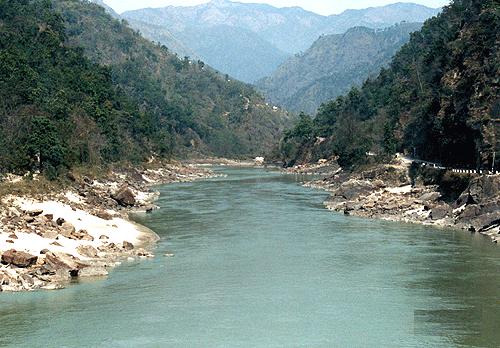
I don’t know if on your walks you have noticed a long, narrow pool beside the river. Some fishermen must have dug it, and it is not connected with the river. The river is flowing steadily, deep and wide, but the pool is heavy with scum because it is not connected with the life of the river, and there are no fish in it. It is a stagnant pool, and the deep river, full of life and vitality, flows swiftly along.
Now, don’t you think human beings are like that? They dig a little pool for themselves away from the swift current of life, and in that little pool they stagnate, die; and this stagnation, this decay we call existence. That is, we all want a state of permanency; we want certain desires to last forever, we want pleasures to have no end. We dig a little hole and barricade ourselves in it with our families, with our ambitions, our cultures, our fears, our gods, our various forms of worship, and there we die, letting life go by – that life which is impermanent, constantly changing, which is so swift, which has such enormous depths, such extraordinary vitality and beauty.
Have you not noticed that if you sit quietly on the bank of the river you hear its song – the lapping of the water, the sound of the current going by? There is always a sense of movement, an extraordinary movement towards the wider and the deeper. In the little pool, there is no movement at all; its water is stagnant ... This is what most of us want: little stagnant pools of existence away from life. We say that our pool existence is right, and we have invented a philosophy to justify it; we have developed social, political, economic, and religious theories in support of it, and we don’t want to be disturbed because what we are after is a sense of permanency.
To seek permanency means wanting that which is pleasurable to continue indefinitely, and wanting that which is not pleasurable to end as quickly as possible. We want the name that we bear to be known and to continue through family, through property. We want a sense of permanency in our relationships, in our activities, which means that we are seeking a lasting, continuous life in the stagnant pool; we don’t want any real changes there, so we have built a society which guarantees us the permanency of property, of name, of fame...
Life is like the river: endlessly moving on, ever seeking, exploring, pushing, overflowing its banks, penetrating every crevice with its water. But the mind won’t allow that to happen to itself. The mind sees that it's dangerous, risky to live in a state of impermanency, insecurity, so it builds a wall around itself ...
Religion is the feeling of goodness, that love which is like the river, living, moving everlastingly. In that state ... there is no longer any search at all, and this ending of search is the beginning of something totally different. The search for God, for truth, the feeling of being completely good – not the cultivation of goodness, of humility, but the seeking out of something beyond the inventions and tricks of the mind, which means having a feeling for that something, living in it, being it – that is true religion. But you can do that only when you leave the pool you have dug for yourself and go out into the river of life.
Sunday, July 4, 2010
Winning hearts and minds

Some people have inherent special qualities that enable them to master all situations. Such individuals can, when they come to a gathering, win the hearts and minds of people simply by making an appearance there. It is said of them: “They came, they saw, they conquered.”
This kind of ability to win love is not the monopoly of extraordinary people. Any ordinary person also can win the hearts and minds of people, provided he knows the law of nature and can avail of it by the power known as the power of spirituality.
According to the Creation Plan of God, all human beings have two different qualities: ego and conscience. The ego symbolises arrogance, and the conscience, modesty. For instance, there could be a difference of opinion between two individuals, A and B. A might enter into a heated exchange, refusing to give B due respect and honour. This kind of behaviour is bound to provoke B, who might try to teach A a lesson. A psychologist offers this analysis: “When one’s ego is touched, it turns into super ego and the result is breakdown.”
In this case A presented a challenge to B and B’s ego gained the upper hand due to arrogance. On the other hand, if, instead of getting provoked and acting out of ego, had B had opted for a compromise, or if A had restrained himself from provoking B in the first place, there would be no conflict.
In all likelihood, greater understanding would enable better relations between A and B; they would no longer be rivals bent on outdoing the other. There is scope for friendship now where earlier, there was only ill feeling. When one’s conscience is touched, it turns into super conscience and the result is complete surrender.This formula is within our reach, and can be used quite successfully. However there are certain risks involved.
There is every possibility that in a sensitive situation where the ego is involved, the other person becomes even more arrogant. He will react more aggressively. He will be more dangerous than before. But that is only if you allow the ego to become your master. The ego is a bad master but a good servant. Fear of a situation arising in which one is completely directed by the ego is unfounded, because when the ego gains predominance it is because of ignorance of the power of nature, or more precisely, the power of spirituality. So all one needs to do is to try and be less ignorant; to learn how to think positive and keep one’s ego under control.
According to nature if you challenge someone’s ego, your success is doubtful but when you challenge someone’s conscience, then your success is guaranteed by nature.
People generally know the power of fighting but a wise man will tell you that the power of spirituality is greater than the power of either ego or conscience. At the time of a controversy, if you choose to fight, you will need arms but when you opt for the spiritual method, you don’t need any arms. The power of positive behaviour can triumph over the power of negativity, while the power of negativity cannot win anything -- it can only lead to destruction.
The choice is ours: To opt for positive, peaceful methods to create better understanding and oneness, thereby contributing to universal togetherness with compassion and surrender or to take a combative stand, giving the ego a free hand, causing unhappiness all around.
Thursday, June 17, 2010
Golden Egg Technique

When you purify your centre, you become receptive to higher vibrations. Creativity happens in this space.
Carnatic music composer Thyagaraja discovered a new raga by listening to a bee. A monk observing a snake and a crane fighting discovered the martial art, Tai Chi.
When your centre is full of impurities, your perspective and understanding are confused. This confusion tends to act as blockages and so there is no scope for the blossoming of creative ideas. Hence there is the need to set about clearing the obfuscation.
When purification happens higher vibrations flow in. New ideas become understandable. We should thus insulate ourselves from negativity and keep our centres pure and receptive, so that the higher states of consciousness can guide us.
There’s a technique called the golden egg technique: Imagine that there is an egg and in it there exists gold. The gold is hidden inside the egg. Treat every problem you encounter as one such egg. Imagine that there is a golden opportunity hidden inside every problem. Whenever you are faced with a problem, don’t lose hope. Instead of getting disheartened, try to understand that it is only an egg with precious gold tucked away deep inside. Delve deep into the problem and recognise golden opportunity. This attitude will invoke creativity in you.
Here are many more ways of dealing positively with problems. Try this. When you come face to face with a problem, think of at least 20 ways of dealing with it. Play a game. Write down all the possible solutions. OK, now that you’ve written down 20 options, choose five out of the 20 and begin working on them. With those five kinds of solutions, find 20 ways of fulfilling them. Ask your friends to give ideas. The mother of creativity is the attempt to generate ideas. Play with it.
There are no winners in an argument. Hence use words wisely. When someone expresses something, try and understand their point of view instead of branding and labelling them as something or other. The moment you brand them, you will see only the labels. As a result you miss seeing the person.
Stop treating differences as conflicts. View them as points of view. Learn to appreciate variety. Appreciate differences rather than viewing them as pain. The moment you relate to differences as pain, you will experience them as pain. View differences as creative versions and you will feel positive energy flow through you.
Monday, June 14, 2010
Smile Smile Smile .... :D ,

A research done in England found that a baby smiles 400 times a day, an adolescent 17 times and an adult doesn't smile at all! The more successful one keeps a very stiff face. Is roughness a sign of success? Is being stressed a sign of prosperity, growth or dignity?
You should smile more. Every day, every morning, look at the mirror and give a good smile to yourself. You know what happens when you smile? All the muscles in your face get relaxed. The nerves in your brain get relaxation, and you get the confidence, courage and energy to move on in life.
You know, your smile is so fragile! Just one telephone call is enough to take it away! Just see why your smiles go away? It may be because somebody said something stupid to you. And why did they say a stupid thing? Because they had some garbage they needed to throw out and you were there, ready to catch it! And once you have caught it, you hold on to it so passionately!
Wake up! Don't let your smile be snatched away by anybody!
Subscribe to:
Posts (Atom)